Introduction
Vibratory bowl feeders are the backbone of automated parts handling in industries ranging from automotive to pharmaceuticals. Understanding how they work helps engineers select, configure, and maintain them effectively.
The Electromagnetic Drive
At the core of every vibratory feeder is an electromagnetic drive unit. When alternating current passes through the coil, it creates a rapidly fluctuating magnetic field that causes the armature — connected to the bowl — to vibrate at the supply frequency (50 Hz in India). The drive operates on the principle of resonance: leaf springs connecting the bowl to the drive base are tuned to resonate near the drive frequency, dramatically amplifying the vibration amplitude for a given power input.
Leaf Spring Mechanics
Leaf springs serve two functions: they provide the restoring force that causes the bowl to return after each drive impulse, and they store potential energy at one end of the vibration cycle to release it at the other. Choosing the correct spring thickness and count is critical — springs that are too stiff reduce amplitude; springs that are too flexible shift the natural frequency below the drive frequency, causing erratic motion.
Part Orientation and Tooling
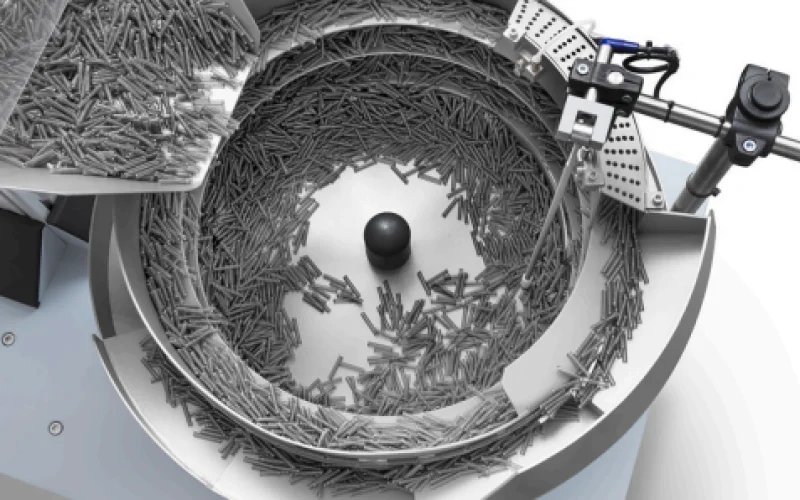
The bowl interior is fitted with a helical track that spirals upward from the base. As parts travel up the track, they pass through a series of tooling features — wiper blades, escape slots, ledges, and air jets — each designed to eliminate parts that are not in the correct orientation. Only correctly oriented parts make it to the outlet.
Feed Rate Control
Feed rate is adjusted by varying the vibration amplitude through a variable-speed controller (potentiometer or digital amplitude controller). Higher amplitude means faster part movement but also greater energy consumption and wear. The optimal setting balances throughput with long-term reliability.
Conclusion
A well-engineered vibratory bowl feeder, correctly tuned and maintained, can run reliably for years with minimal downtime. Kalapremi Industries designs each feeder specifically for the customer's part, ensuring optimal performance from day one.